Welcome
This app is a learning aid on Lead Management based on the book, Using Lead Management on Purpose by Kenneth L. Pierce. Read the references here and use the Recall section to help you to remember the key concepts and ideas. Use the Q&A section which is AI driven to sharpen your understanding on the subject.
How to use this app
Reference
Work through the core concepts chapter by chapter — Choice Theory's foundations, the five basic needs, the Hierarchy of Being, Boss vs. Lead Management, and the tools Lead Managers use (caring communication, "A Walk in the Park"). Each chapter ends with its Seven Key Points.
Recall
Test yourself with flip cards drawn from the glossary and key frameworks. Tap a card to reveal the answer, filter by topic deck, and shuffle to keep it fresh.
Q&A
Talk to the AI tutor to test your understanding, get a concept explained a different way, or explore how a principle applies to a real situation you're facing. The tutor stays inside the world of this book.
Resources
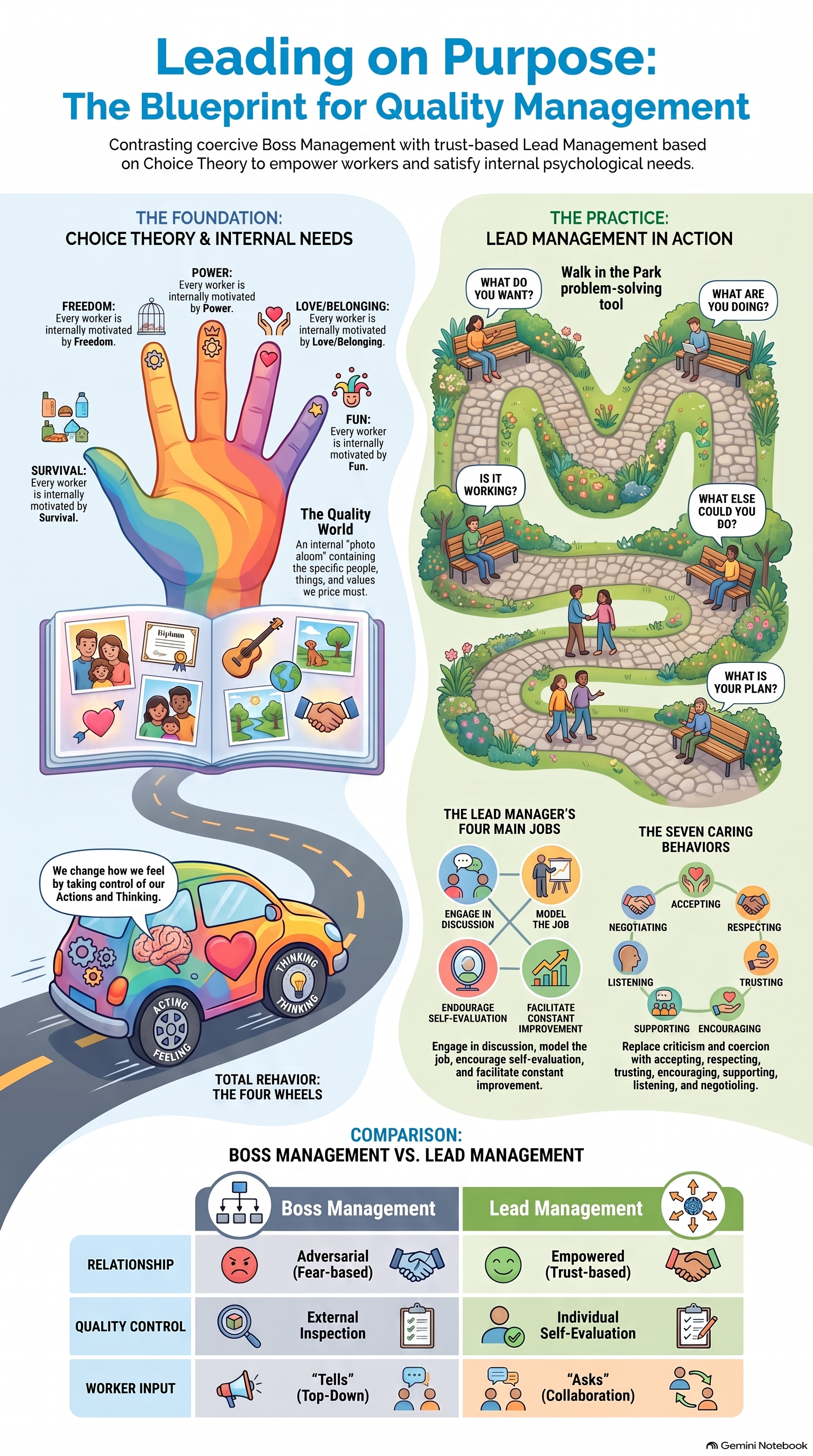
Listen to the companion podcast on the go, and save the one-page infographic to your phone as a quick-reference card.
The core idea, in one line
"My supervisor can buy my time and my attendance at work, but if he wants my creativity, enthusiasm and commitment, I have to choose to give it to him."
Everything in this book follows from that sentence. You cannot coerce quality out of anyone — you can only lead them toward choosing it.
Core Concepts
referenceChoice Theory® vs. External Control ▸
Boss-managers operate on External Control Psychology: the belief that reward and punishment can make people do what you want. Choice Theory® holds the opposite — we cannot make anyone do something they do not choose to do. All behavior is our best attempt, at the time, to satisfy our needs and honor our values.
"The only reasonable expectation you can have of people is that they will live according to their own values." — John Demartini
The Hierarchy of Being — five levels of thinking ▸
Adapted from Robert Dilts, this describes five levels at which a person operates, each including the one below it:
- Behaviors — what we actually do (acting energetic, acting bored)
- Strategies — the thinking behind the behavior ("I'll do the best job possible")
- Beliefs — the perspective that generates the strategy (feeling valued vs. feeling like a cog)
- Identity — the source of the belief ("my job is part of who I am")
- Spirit — how the work connects to one's larger purpose
Boss-managers are usually only aware of the bottom two levels — Strategies and Behaviors. Lead Managers operate consciously at all five, which is why they can inspire rather than merely instruct.
The Five Basic Human Needs ▸
Choice Theory® groups our genetic drives into five needs — pictured as the five fingers of a hand:
- Survival — food, safety, shelter (the only physiological need of the five)
- Freedom / choice — having a say in what matters to us
- Power / recognition — being listened to and making a difference
- Love / belonging — friendship and connection
- Fun / progress — the genetic reward for learning and growing
All pain, in Choice Theory®, is the result of a loss of control that prevents us from satisfying these needs. A workplace that only meets Survival will get only survival-level effort.
Total Behavior — the four-wheeled car ▸
Every behavior has four inseparable components, like the four wheels of a front-wheel-drive car:
- Acting/doing — the physical activity (front wheel — we steer here)
- Thinking — what we tell ourselves (front wheel — we steer here)
- Feeling — the emotion generated (back wheel — follows)
- Physiology — the bodily response (back wheel — follows)
We have direct control only over acting and thinking. Feelings and physiology follow. This is the mechanism behind self-control: change what you do and think, and feeling follows.
The Quality World ▸
Each of us carries an imagined "photo album" of people, places, things, and ideas we've discovered feel need-satisfying — Glasser calls this the Quality World. Behavior is driven by the gap (the void) between what's in our Quality World (what we want) and what we perceive in the real world (what we have).
For a worker to pursue quality work, the manager, the work itself, and the customer all need a place in that worker's Quality World. That is the Lead Manager's real task.
Boss Management vs. Lead Management
the core contrastBOSS MANAGER'S JOB
- Sets task and standard
- Tells, not shows
- Inspects the work
- Uses coercion or punishment
LEAD MANAGER'S JOB
- Engages workers in ongoing discussion
- Models the job
- Asks workers to self-evaluate
- Teaches that quality is continuous
None of the Boss Manager's four points offer freedom, power, love/belonging, or fun. Coercion produces adversaries, not quality — and fighting a boss with little hope of winning drains exactly the energy that quality work requires.
The Three Conditions for Quality ▸
- The work environment is respectful, warm, and supportive, with managers who are trusted.
- Workers do only useful work and are encouraged to contribute to its usefulness.
- Managers expect every worker to continually evaluate — and improve — his or her own work.
Seven Behaviors that Destroy Relationships vs. Seven Caring Behaviors ▸
Avoid: CriticizingBlamingThreateningBribingPunishingComplainingNagging
Practice: AcceptingRespectingTrustingEncouragingSupportingListeningNegotiating
Demartini frames three levels of relating: Careless (my values matter, yours don't), Careful (your values matter, mine don't), and Caring (I insert my values inside yours — in business, this is also called selling).
Lead Manager as Friend, Coach, and Teacher ▸
Beyond managing, a Lead Manager relates in three additional ways:
- Friend — shares interest and asks rather than demands ("How do you suggest we go about it?")
- Coach — offers information or perspective to someone who has asked for it; coaching is voluntary and stops the moment help is refused
- Teacher/Modeler — runs the workplace as a learning organization where the only real test is: does it improve the quality of the work?
"A Walk in the Park" — the five benches ▸
A non-coercive, Reality-Therapy-based counseling model Lead Managers use to help a worker solve a problem — at work or in life — without blame or judgment:
- Want Bench — What do you want?
- Doing Bench — What have you been doing to get it?
- Self-Evaluation Bench — Has what you've been doing worked?
- Options Bench — What else could you do to get what you want?
- Planning Bench — Are you ready to make a plan?
The worker evaluates their own choices — never the manager. That self-evaluation is what frees them to let go of what hasn't worked and get creative about what might.
Seeing It in Action
a worked exampleMarie & Jacqueline — "A Walk in the Park" in practice ▸
Jacqueline, an Assistant Director at the Millennium Community Hospital, complains to Marie that she doesn't have enough help to do her job: "There is just too much work!" Marie suspects Jacqueline isn't working inefficiently so much as stuck in old habits, and arranges to take her for "A Walk in the Park."
1. Want Bench — What do you want?
2. Doing Bench — What have you been doing to get it?
3. Self-Evaluation Bench — Has what you've been doing worked?
4. Options Bench — What else could you do to get what you want?
5. Planning Bench — Are you ready to make a plan?
Notice what Marie never does: she doesn't step in with threats, take over the problem, or impose a solution. Every new behavior — and the plan itself — comes from Jacqueline. That self-evaluation is what makes it hers to keep.
Chapter Key Points
10 chaptersFlip Cards
Q&A
AI-guidedPodcast
listenWhy Bossing Fails — and Lead Management Works
A short audio walkthrough of the book's core ideas, for listening on a commute or a walk.
Infographic
save to phoneLeading on Purpose: The Blueprint for Quality Management
A one-page visual summary of Choice Theory®, the five basic needs, "A Walk in the Park," and Boss vs. Lead Management. Save it to your camera roll for a glance-and-go reminder.